
A couple of weeks ago, I wrote about five wedding stresses couples blame on everything except design. A few of you asked a great follow-up question: when do those stresses actually hit?
That’s exactly what a journey map answers. So this week, I mapped the entire South Asian wedding planning experience, from the first “we’re engaged!” to the last thank-you note.
What Is a Journey Map?
A journey map is a visual story of someone’s experience over time. It goes beyond what people do to show how they feel at each step, where things get hard, and where a product could make a real difference.
For Shaadi Simplified, it answers three big questions:
When do couples feel the most stress?
Why do they feel it?
Which features should help, and when?
Step 1: From Messy Notes to Clear Themes
Before drawing anything, I gathered every pain point I’d collected while building my personas. Then I grouped similar notes together until patterns appeared. This process is called affinity mapping, and it’s one of my favorite parts of research.
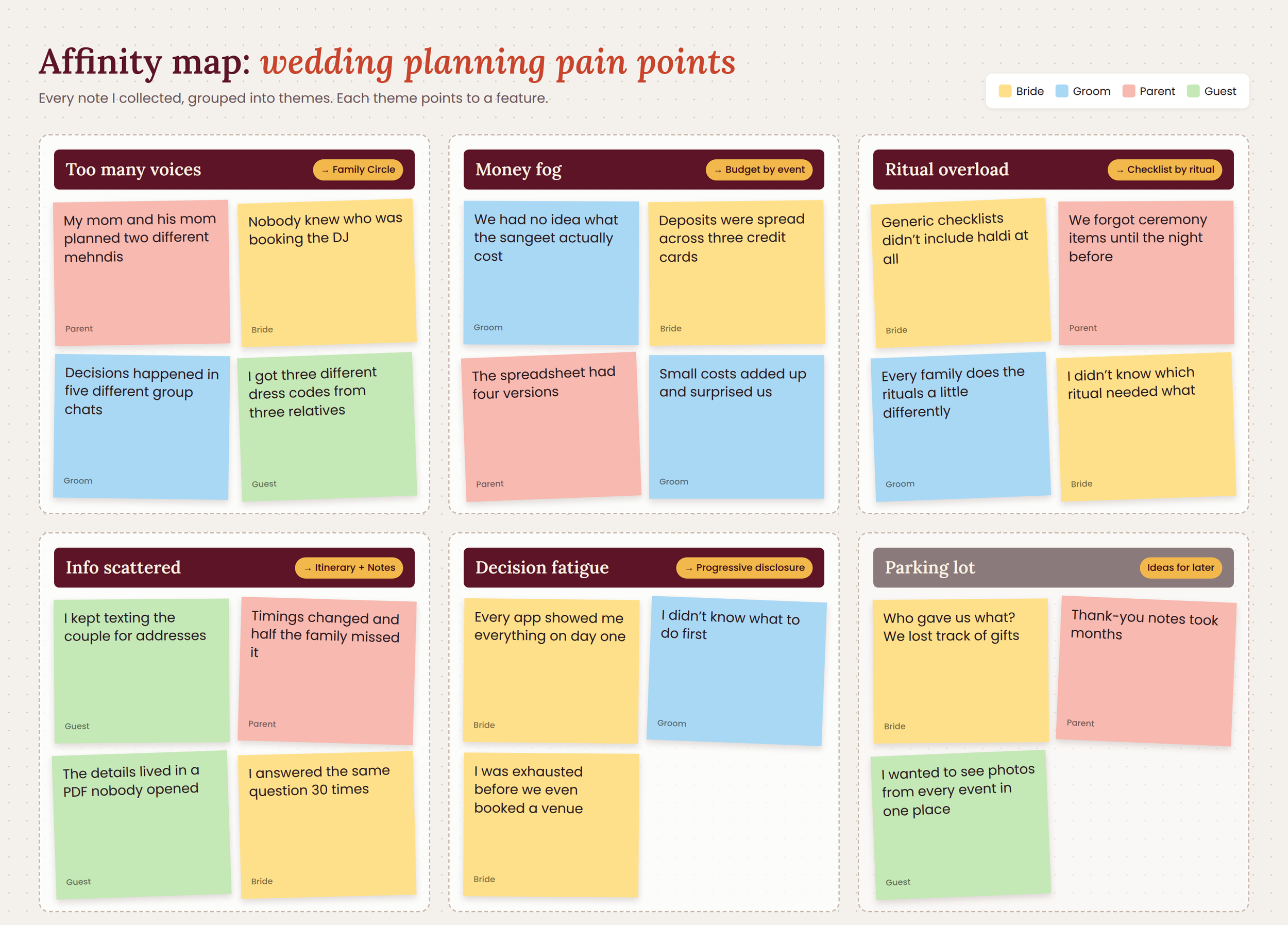
Affinity mapping in action: real pain points from couples and families, grouped into themes that shaped my features.
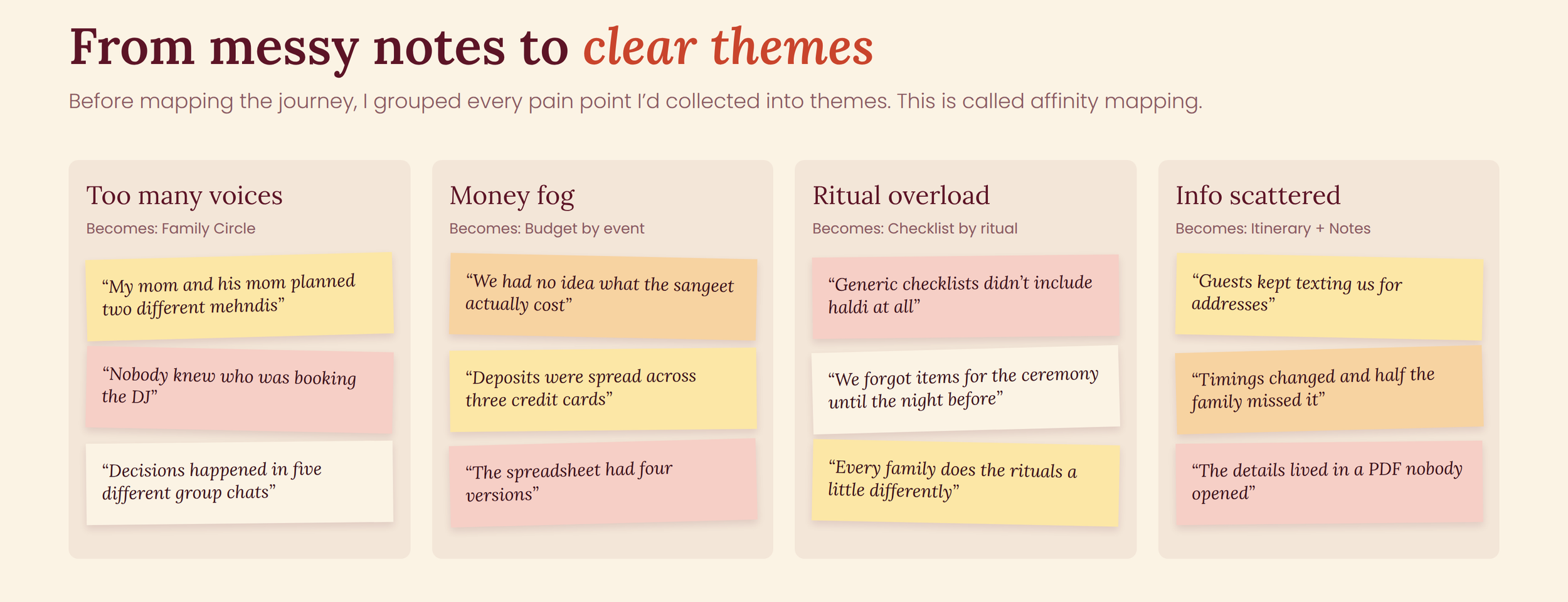
Sticky notes grouped into four themes.
Four themes jumped out right away:
Too many voices: Decisions get spread across family members and group chats.
Money fog: Costs are hard to track across multiple events.
Ritual overload: Generic tools don’t understand South Asian ceremonies.
Info scattered: Event details live everywhere and nowhere.
Each theme turned into a feature on my roadmap. But themes alone don’t tell me when to show up for couples. That’s where the journey map comes in.
Step 2: Mapping the Journey
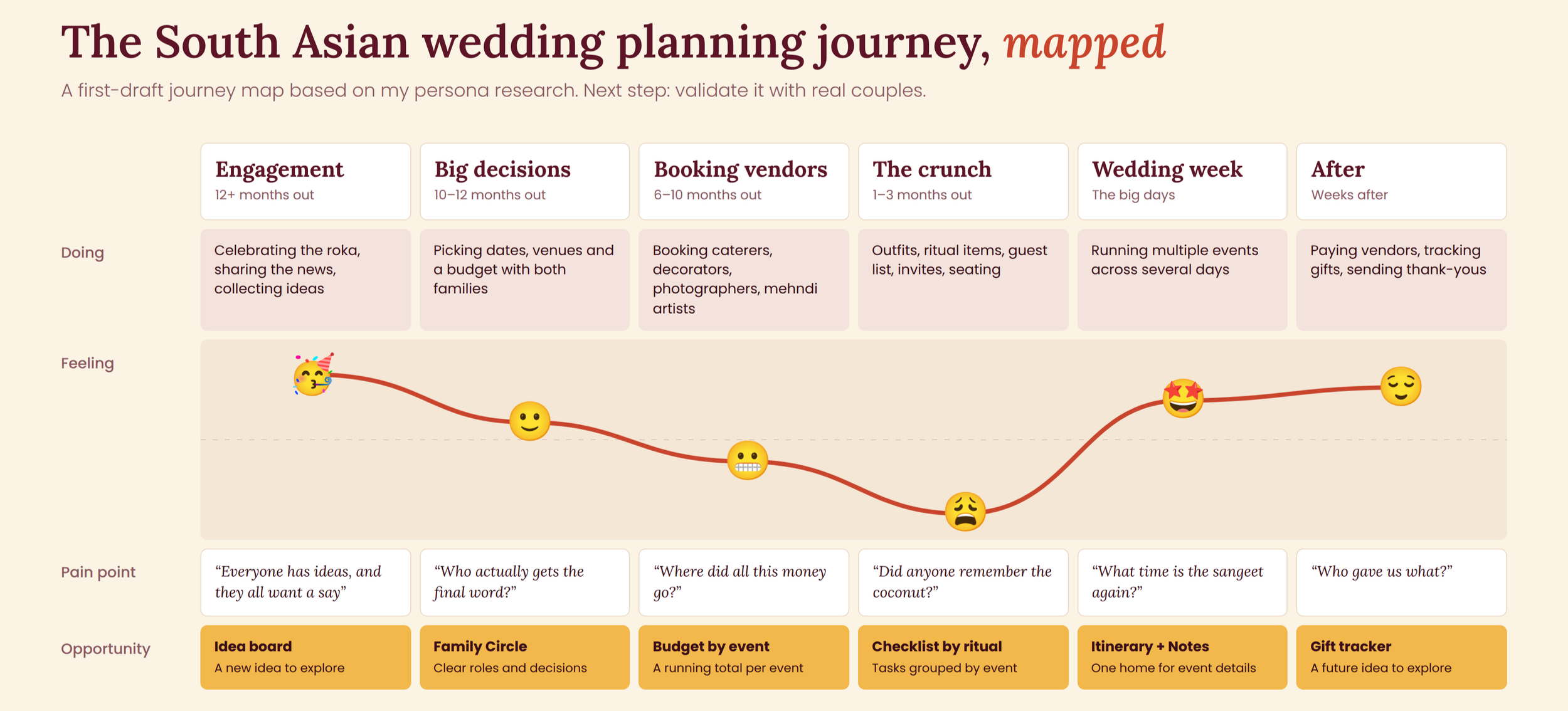
Journey map of six wedding planning stages.
I broke the experience into six stages:
Engagement (12+ months out)
Pure excitement! The roka is done, the news is out, and ideas are flowing from everywhere. Maybe too many places.
Big decisions (10–12 months out)
Dates, venues, budget. It’s still exciting, but this is where two families start negotiating, and nobody’s quite sure who has the final word.
Booking vendors (6–10 months out)
Caterers, decorators, photographers, mehndi artists. Deposits pile up across events, and the budget gets foggy fast.
The crunch (1–3 months out)
The lowest point. Outfits, ritual items, guest lists, seating, invites, all at once. This is when things get forgotten and stress peaks.
Wedding week
Joy takes over! But running multiple events across several days means constant “what time is the sangeet?” messages.
After
Relief, mixed with leftover admin: final vendor payments, tracking gifts, and thank-you notes.
What the Map Revealed
The crunch is where Shaadi Simplified matters most. The emotional curve bottoms out one to three months before the wedding. My ritual-based checklist has to be at its strongest there, because the details are piling up and the stakes are highest.
Stress starts earlier than I expected. I assumed the hard part started with vendors. But the map shows tension beginning at the big decisions stage, when families start weighing in. That makes Family Circle more urgent than I thought.
The journey doesn’t end at the wedding. Mapping the “after” stage surfaced a brand-new idea: a gift tracker. Who gave what, and have we sent a thank-you? It’s not in the MVP, but it’s going on the idea list. 📝
Features should show up when they’re needed. This connects back to progressive disclosure from my “5 stresses” post. A couple 12 months out doesn’t need seating charts yet. The journey map tells me what to show, and when.
A Quick Reality Check
This is a first-draft journey map built from my persona research. It’s a hypothesis, not a fact. The next step is to put it in front of real couples and ask: Does this match your experience? What did I miss?
Good design means being honest about what you know and what you’re still assuming.
Married (or helped plan a wedding)? Where did your stress peak? Does my map match your experience? Tell me in the comments. Your answers will help me validate this map! 😊